The Ministry of Finance has kicked off 2026 with a landmark shift in the taxation of demerit goods. Through a series of critical notifications issued on December 31, 2025, the government has overhauled the tax structure for tobacco and pan masala, moving away from the long-standing “28% + Compensation Cess” model toward a more streamlined, yet intensive, regime effective February 1, 2026.
Below is a comprehensive analysis of the key changes every stakeholder must know.
1. The New GST Rate Structure (Notification No. 19/2025)
The most immediate change is the removal of tobacco products from the now-defunct 28% slab. Instead, these products have been redistributed into new, higher brackets to ensure revenue neutrality as the Compensation Cess is phased out.
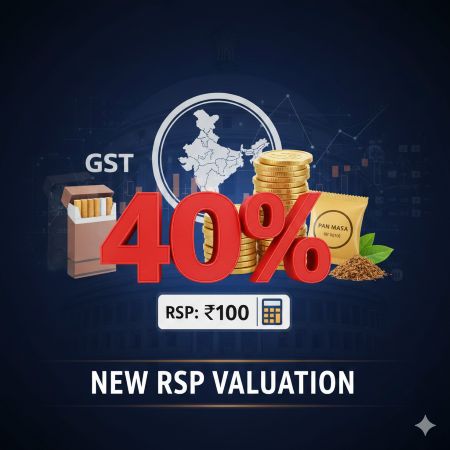
- The 40% “Sin Tax” Slab: Most tobacco products, including cigarettes, cigars, pan masala, and unmanufactured tobacco, will now attract a total GST rate of 40% (20% CGST + 20% SGST/UTGST).
- Relief for Biris: In a notable move, biris (HSN 2403 19 21/29) have been moved to the 18% slab (9% CGST + 9% SGST), providing a significant rate reduction compared to the previous 28%.
- Effective Date: These revised rates come into force on February 1, 2026.
2. Shift to Retail Sale Price (RSP) Valuation (Rule 31D)
Under the new Rule 31D (inserted via Notification No. 20/2025), the valuation for GST will no longer be based on the “transaction value” for specified goods. Instead, it will be based on the Retail Sale Price (RSP) or MRP printed on the package.
How it Works:
- Tax-Inclusive Pricing: The RSP is treated as inclusive of all taxes.
- The Formula: To determine the taxable value, the tax is “backed out” from the RSP using this formula:Tax Amount = (RSP × Tax Rate) / (100 + Sum of Applicable Tax Rates).
- Multiple RSPs: If a package carries more than one RSP, the highest price will be used for valuation.
- Regional Variations: If different RSPs are declared for different states/areas, the specific RSP for that area will apply.
3. Exemption for Dealers and Rule 86B (Notification No. 20/2025)
To protect downstream distributors and retailers from the complexities of RSP-based calculations, the government has amended Rule 86B.
- Non-Manufacturers Exempt: Registered persons other than manufacturers are exempt from the RSP-based valuation provisions of Rule 31D, provided the manufacturer/supplier has already discharged the tax on an RSP basis.
- ITC Relief: This ensures that traders are not unfairly restricted in their use of Input Tax Credit (ITC) for these specific goods.
4. The End of Compensation Cess and the Rise of New Levies
As of February 1, 2026, the GST Compensation Cess will effectively cease for these items. However, the total tax burden remains high due to:
- Health and National Security Cess: A new dedicated cess under the Health Security and National Security Act, 2025, which will fund specific national initiatives.
- Revived Central Excise: Higher specific excise duties and machine-capacity-based levies for chewing tobacco and cigarettes are being reintroduced to compensate for the end of the GST cess.
Action Points for Businesses
- System Updates: Manufacturers must update ERP and invoicing systems to reflect the 40% GST rate and the new back-calculation formula for RSP-based valuation.
- Price Review: Pricing strategies must be carefully aligned with the declared RSP, as any alteration to increase the RSP will immediately trigger a higher GST liability.
- Compliance Filing: Ensure all declarations regarding machine capacity (for specific tobacco products) are filed correctly by the upcoming deadlines in February 2026.
Conclusion: The transition to an RSP-based regime is a clear attempt by the CBIC to eliminate “undervaluation” and simplify a historically litigious sector. While the 40% rate may seem steep, the consolidation of taxes and the removal of the Compensation Cess provide much-needed structural clarity for the industry.
For more daily updates and detailed circular summaries, stay tuned to www.gstindianews.info.